
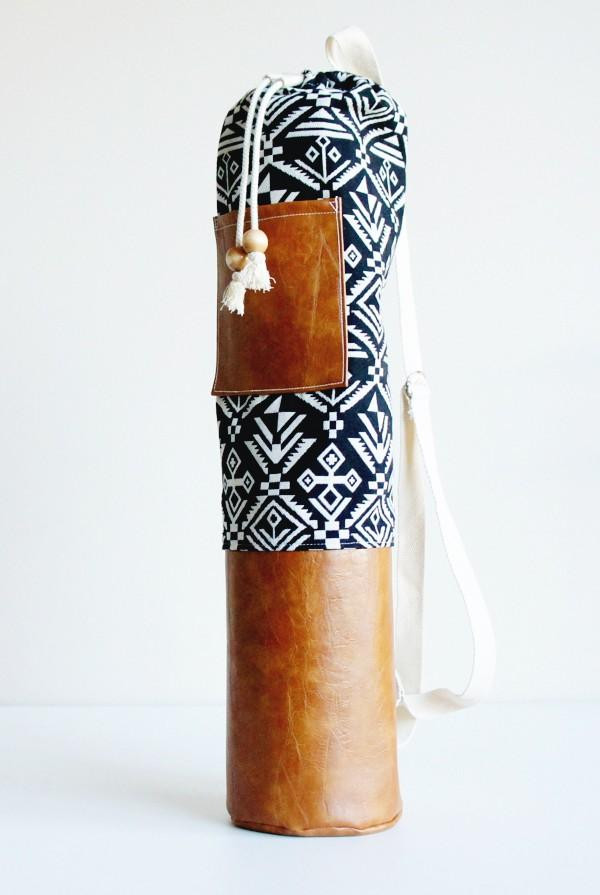
Instead of chucking your mat in the back of the car on the way to your next exercise class, why not pop it in a stylish bag? This one features a contrast base, outside pocket, drawstring closure and adjustable strap. The sample shown uses bottom weight and vinyl, but any two heavier fabrics will do – canvas, linen, or whatever home décor fabric you’ve got handy. The PFAFF® passport 3.0’s patented IDT™ system makes stitching through all sorts of fabrics a breeze.
This bag is made to fit a standard yoga mat, about 61cm x 173cm
Sewing Supplies:
- PFAFF® passport™ 3.0 sewing machine
- 0A Foot
- Buttonhole Foot
- INSPIRA® Microtex Needles Size 90 [P620104396]
- Small scrap of tearaway stabiliser or interfacing
- Main Fabric: 70cm home décor weight fabric (black and white shown in photos)
- Contrast Fabric: 30cm home décor weight fabric (brown shown in photos)
- Three 25mm metal D-rings
- 1.8m of 25mm cotton webbing
- 90cm of 6mm cotton cording
- 2 large beads (optional)
- Sewing thread
- Water-soluble marking pen
- Masking tape or painter’s tape (if using vinyl or leather for either fabric)
- Binding clips or paperclips (if using vinyl or leather for either fabric)
- Basic sewing tools
Cut:
From Main Fabric:
1 piece 52cm W x 51cm L (upper bag)
From Contrast Fabric (Fabric B):
1 piece 52cm W x 25cm L (lower bag – notch centre of bottom edge)
1 piece 18cm diameter circle (base – template provided)
1 piece 16.5cm W x 19cm L (pocket)
From Webbing:
1 piece 122cm L (strap)
1 piece 25cm L (top loop)
1 piece 20cm L (bottom loop)
1 piece 8cm L (drawstring stop)
Sew
All seam allowances are 1cm unless otherwise specified.
If working with vinyl or leather, avoid using pins – opt for quilt binding clips or paperclips instead.
1. Thread the machine with sewing thread and bobbin. Attach the 0A foot and engage the IDT™ system. Select stitch 06 (three-step zigzag).
2. Stitch along the sides and bottom of the upper bag with a 3mm seam allowance to finish the raw edges.
3. Select stitch 01 (straight stitch) .With right sides together, align the bottom edge of the upper bag with the top edge of the lower bag. Stitch, then press the seam allowance towards the upper bag (if using vinyl, press on a low heat with a pressing cloth). Increase
4. Fold the top edge of the pocket 1.5cm to the wrong side twice and press. (If using leather or vinyl, fold once at 2.5cm). Stitch along the lower folded edge to secure.

5. Fold the remaining three edges 1.5cm to the wrong side and press. Topstitch around the three edges with a 3mm seam allowance.
6. Fold both the bag and pocket in half vertically to find the centres; mark them. Place the pocket on the bag, aligning the centres, with the bottom edge positioned 13cm above the contrast seam. Pin in place (or use painter’s tape to secure).

Topstitch around the three sides of the pocket, following the previous stitching line, backstitching at the start and end. Stitch a triangle in each upper corner as shown for extra strength .

7. Optional: Leave a 1.5cm gap in the bottom corner of your pocket stitching to create an opening for earphone cords.
8. Fold the top edge of the upper bag 1.5cm to the wrong side and press. Fold another 2.5cm and press. Unfold. Mark two buttonhole positions, both 6mm below the lowest fold and 1.5cm to either side of centre.

9. Adjust the Buttonhole Foot so the space between the prongs measures 2cm.
Attach the Buttonhole Foot and select stitch 15 (buttonhole). Place interfacing or stabiliser behind the buttonhole marks. Position the bag so most of it sits behind the machine, starting at the top of the buttonhole (the machine will stitch backwards first). Stitch both buttonholes. Carefully open with a quick-unpick (seam ripper), starting at each end and cutting into the centre. Tip: always test a buttonhole first on a scrap of your main fabric.

10. Reattach the 0A Foot and select stitch 01 (straight stitch). Thread the 20cm loop of webbing through one D-ring and align the ends. Stitch a square with an X just below the D-ring. Trim ends at a 45° angle. Align the raw edge of the strap with the right side of the lower bag, 10cm below the contrast seam, angled towards the top of the bag.
Stitch in place with a 6mm seam allowance.

11. Fold the bag in half lengthways, right sides together, and align side edges. Keep the top folds unfolded. Stitch together and finger-press the seam open.
12. Pin or clip the base circle to the bottom of the bag, right sides together. Start by matching the notches and side seam, then ease the rest into place.
Stitch carefully all the way around, keeping edges aligned. It’s easier to sew with the base against the machine bed. Clip notches into the seam allowance of the base only to release excess fabric.

13. Refold the top edge along the pressed creases and pin. Stitch close to the lower fold all the way around.
14. Thread one end of the 1.2m strap through both remaining D-rings. Fold the end back 4cm, tuck the raw edge under, and stitch a square with an X to secure.

Thread the opposite raw end of the strap through the D-ring on the lower loop.

15. To make the strap adjustable, thread the raw end through both main strap D-rings.

then back through just one D-ring. Adjust until strap length is around 90cm.

16. Fold the upper loop in half with a slight twist. Stitch 6mm from the raw edge to secure. Fold the raw end of the main strap around the bottom of the upper loop to enclose raw edges. Pin to the bag, centred on the side seam and positioned 7.5cm below the top edge. Ensure the strap isn’t twisted. Remove the machine’s accessory box for extra space. Stitch a square with an X to secure.

17. Fold the drawstring stop in half and stitch the ends with a 6mm seam allowance. Trim close to the stitching and turn right side out. Flatten with the seam centred. Stitch two lines 6mm apart, across the centre.
18. Thread the cord through the casing at the top of the bag using a safety pin. Feed both ends through the drawstring stop. Add a bead to each end (optional). Knot at your desired length and trim excess. Tease out the cord ends below the knot to create a tassel.
19. Thread the cord through the casing at the top of the bag using a safety pin. Feed both ends through the drawstring stop. Add a bead to each end (optional). Knot at your desired length and trim excess. Tease out the cord ends below the knot to create a tassel.

We can’t wait to see what you create! Don’t forget to share them with us on Instagram, tagging @pfaffsewingaus and using the hashtags #pfaffsewingaustralia #pfaffsewing #perfectionstartshere, or on our Facebook page, Pfaff Australia.